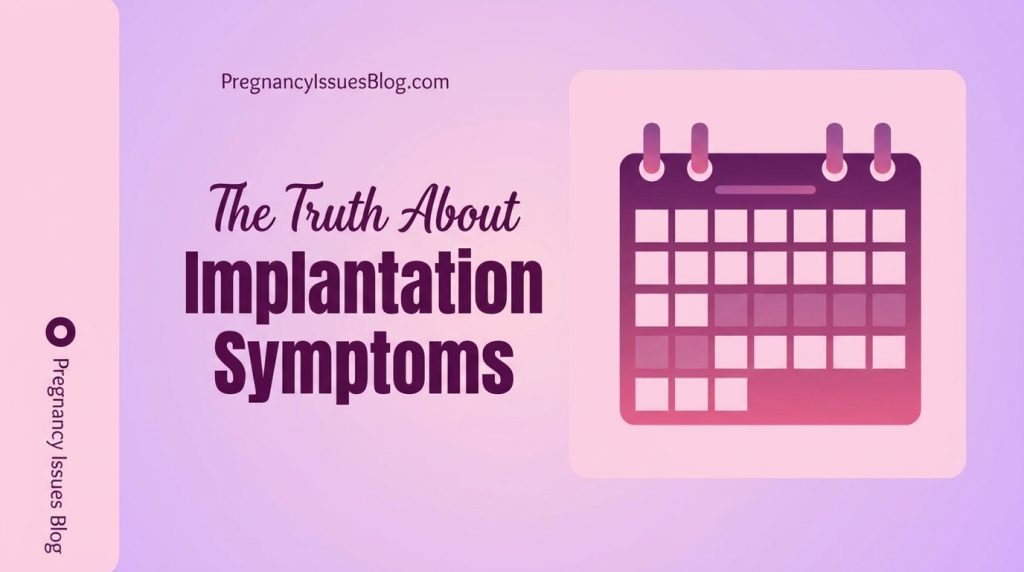
The moment of implantation is often treated like the “Holy Grail” of the Two-Week Wait.
It is the literal bridge between being “technically” pregnant and having an embryo successfully call your uterus home.
Because the stakes are so high, the internet is flooded with anecdotes about “feeling the spark” or “knowing the exact second it happened.”
But what does science actually say?
Let’s separate the biological reality from the hopeful myths.
Implantation Symptoms (Real vs. Myth)
-
Introduction: Defining the biological window of implantation.
-
The Science of the Shift: What is actually happening in the uterine wall?
-
Real Sign #1: Implantation Bleeding: The color, timing, and frequency.
-
Real Sign #2: The “Implantation Dip”: What your BBT chart might reveal.
-
Real Sign #3: Mild Uterine “Tugging”: Why it’s not a standard cramp.
-
Myth #1: Immediate Morning Sickness: Why your stomach isn’t involved yet.
-
Myth #2: Intense Pelvic Pain: Differentiating implantation from other issues.
-
The “hCG” Reality Check: Why symptoms don’t always equal a positive test.
-
Conclusion: Navigating the “Two-Week Wait” with a level head.
The Biological Event: What’s Happening?
Implantation typically occurs between 6 and 12 days post-ovulation (DPO), with 8–10 DPO being the most common “sweet spot.”
At this stage, the blastocyst (a tiny ball of cells) burrows into the endometrium (the uterine lining).
This process involves a complex chemical dialogue between the embryo and the mother.
It is a microscopic event, meaning most women will feel absolutely nothing.
However, for a small percentage, the physical changes are detectable.
Real Signs: The Science-Backed Symptoms
1. Implantation Bleeding
This is perhaps the most famous sign, but it’s less common than you think, occurring in only about 30% of pregnancies.
-
The Reality: It is usually light pink or brown, not bright red. It shouldn’t require more than a pantyliner and lasts anywhere from a few hours to two days.
-
The Science: As the embryo burrows, it can disrupt tiny blood vessels in the lining.
2. The “Implantation Dip”
If you are tracking your Basal Body Temperature (BBT), you might see a one-day drop in temperature about a week after ovulation.
-
The Reality: While often seen on “pregnancy charts,” it can also happen on non-pregnancy charts due to a mid-luteal estrogen surge. However, if it’s followed by a sustained rise, it’s a positive indicator.
3. Mild “Tugging” or “Tingling”
Unlike the heavy, radiating ache of a period, implantation “cramps” are often described as light twinges, prickling, or pulling sensations in the lower abdomen.
The Myths: Common Misconceptions
Myth #1: Immediate Nausea
You see it in movies: a woman gets queasy over breakfast and realizes she’s pregnant. In reality, “morning sickness” is caused by Human Chorionic Gonadotropin (hCG).
After implantation, it takes several days for hCG to double enough to affect your brain’s nausea center.
The Truth: True pregnancy-related nausea rarely begins before 4 or 5 weeks of pregnancy.
Myth #2: Intense Pelvic Pain
Implantation is a microscopic process.
If you are experiencing sharp, stabbing, or severe pelvic pain, it is likely not implantation.
This could be related to ovulation, a cyst, or digestive issues. Severe pain should always be discussed with a doctor.
Myth #3: “I felt the moment of conception”
Biologically, conception (the meeting of sperm and egg) happens in the Fallopian tube. There are no nerve endings in the tube that would signal “fertilization” to your brain.
What people usually feel is the hormonal shift that follows days later.
The “Golden Rule” of the Two-Week Wait
The hardest truth to swallow?
Progesterone, the hormone that dominates the second half of every cycle, causes symptoms that perfectly mimic early pregnancy.
Bloating, sore breasts, and fatigue are all “Progesterone symptoms.”
You can have every “real” symptom on this list and not be pregnant, or have zero symptoms and get a “plus” sign next week.
The only definitive way to know the truth is to wait until at least 12 DPO and take a high-sensitivity test.
What is the most unusual symptom you’ve noticed during your current cycle, and are you tracking your basal body temperature to help decode it?