In the landscape of recent technologies, choosing a natural labor isn’t about being a martyr or “proving” something.
It’s a strategic choice to experience birth with full mobility and a front-row seat to the body’s incredible biological mechanics.
But let’s be real: “Natural” doesn’t mean “painless.”
It means managing sensation with a toolkit that works with your nervous system rather than numbing it.
If you’re planning an unmedicated birth, you need more than just willpower.
You need a physiological game plan.
Here are the pain management tips that actually move the needle when the waves get intense.
Table of Contents
Toggle1. The Mindset Shift: Purposeful Sensation
In most contexts, pain is a signal that something is wrong.
In labor, pain is a signal that something is working.
It is the sound of your uterine muscles doing the heavy lifting to bring your baby down.
When you reframe “pain” as “functional intensity,” your amygdala, the brain’s fear center, is less likely to trigger a flood of Adrenaline, which can stall labor.
2. Hydrotherapy: The Midwife’s Epidural
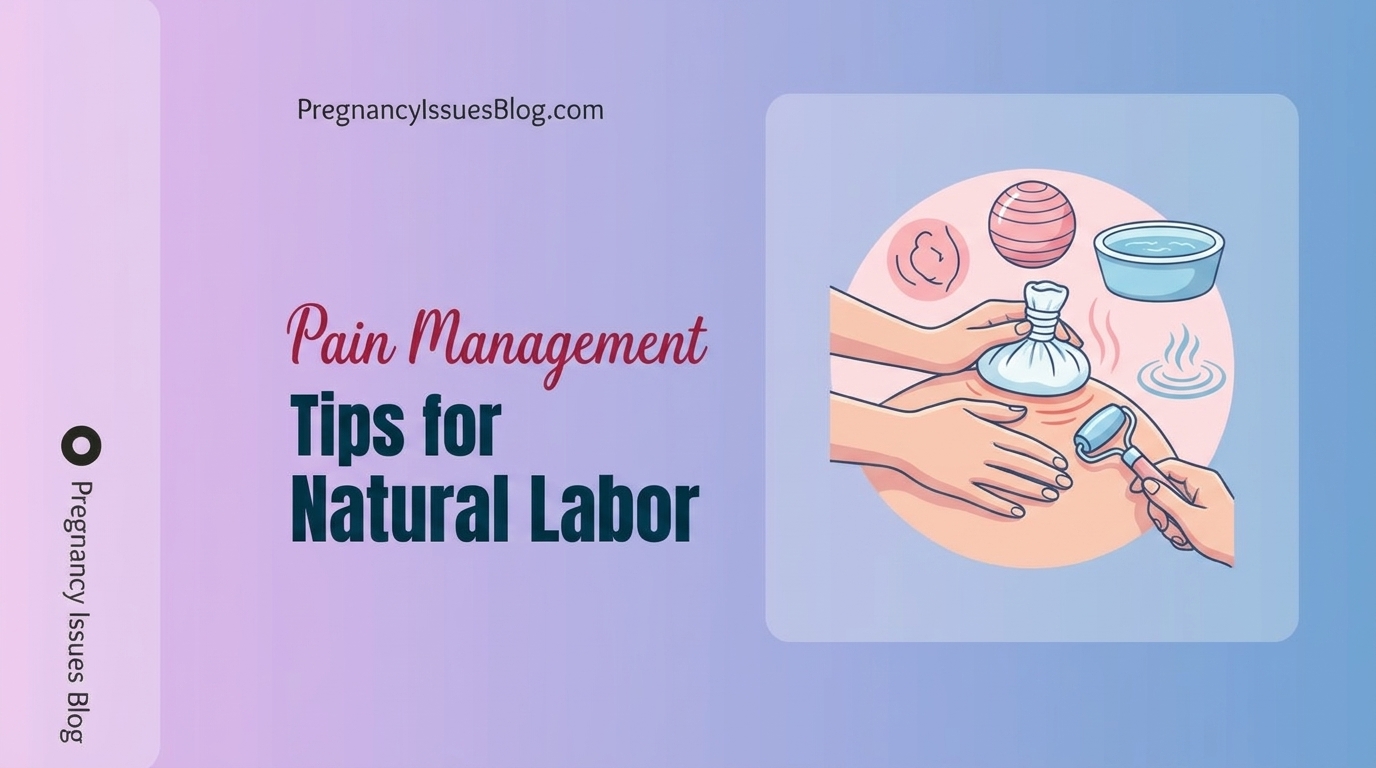
Water is perhaps the most effective non-pharmacological pain relief tool available.
Whether it’s a deep tub or a warm shower, hydrotherapy works on two levels:
-
Buoyancy: It reduces the effects of gravity on your joints and uterus, making it easier to change positions.
-
Temperature: Warm water promotes blood flow and muscle relaxation.
Note: Many women find that getting into the tub too early can slow labor, but hitting the water at 6 -7 cm dilation can be a total game-changer for the transition phase.
3. The Gate Control Theory: Closing the Gate
The Gate Control Theory suggests that the brain can only process a certain amount of sensory information at once.
Large-fiber sensations (like touch, pressure, or cold) travel faster to the brain than small-fiber sensations (pain).
By introducing “competing” sensations, you can essentially crowd out the pain signals.
-
TENS Machines: These send mild electrical pulses to the skin, “occupying” the nerve pathways.
-
Counter-Pressure: Having a partner press firmly on your lower back (the sacrum) during a contraction.
-
Comb Squeezing: Squeezing a simple hair comb so the teeth press into the acupuncture points of your palm.
4. Active Labor: Movement and Gravity
In a natural birth, “staying active” isn’t about exercise; it’s about preventing the baby from getting stuck.
-
Asymmetrical Movement: Curb walking or walking up stairs sideways can help open the pelvis.
-
The Birth Ball: Bouncing and circling the hips helps the baby’s head apply even pressure to the cervix, which encourages dilation.
-
Gravity: Standing or squatting allows gravity to assist the baby’s descent. Every centimeter the baby moves down is a centimeter closer to the finish line.
5. The Breath-Jaw Connection
There is a fascinating physiological link between your jaw and your pelvic floor.
If your jaw is clenched and your throat is tight, your pelvic floor is likely mirroring that tension.
-
The Strategy: Focus on “low and slow” breaths. During a surge, make deep, guttural moans rather than high-pitched screams. Think “Horse Lips”, vibrating your lips to keep your mouth soft. If the mouth is open and relaxed, the birth canal is more likely to follow suit.
Pain Management Toolkit
| Tool | How it Works | Best For… |
| Warm Shower | Hydrotherapy/Heat | Back labor and early active labor. |
| Counter-Pressure | Gate Control Theory | Relieving intense pressure in the sacrum. |
| Birth Ball | Pelvic Mobility | Helping baby rotate and descend. |
| Horse Lips | Vagus Nerve/Relaxation | Keeping the pelvic floor from tensing up. |
| TENS Machine | Nerve Stimulation | Managing the “peak” of contractions. |
Conclusion
The most successful natural births aren’t the ones where the parent “fights” the hardest; they are the ones where the parent surrenders the most.
Labor is a series of waves.
If you try to stand still and resist them, they will knock you over.
If you dive into them and breathe through them, they will carry you to the shore.
Trust your body, use your tools, and remember that every contraction is a one-minute sprint toward meeting your baby.