If the first trimester is about surviving the “morning” sickness and laying down the biological blueprints, the third trimester is about the heavy lifting.
By week 28, you aren’t just growing a tiny seed; you are managing a high-speed construction site that is open 24/7.
Your nutritional needs shift from prevention (preventing birth defects) to performance (building fat stores, strengthening bones, and fueling a massive brain).
Here is why your plate needs to look very different as you approach the finish line.
Table of Contents
ToggleWhy Your Third Trimester Nutritional Needs Are Completely Different From Your First
In the first trimester, your baby is roughly the size of a lime.
Your body is working overtime on organogenesis, forming the heart, brain, and spinal cord.
Nutritionally, this phase is dominated by Folate.
You don’t actually need extra calories yet; you just need the right microscopic building blocks to ensure the blueprints are followed correctly.
Fast forward to the third trimester, and the lime has become a watermelon.
The organs are formed, but they need to be powered, insulated, and strengthened.
Your body’s demands pivot from “micro” to “macro.”
1. The Calorie Math: From Zero to 450
One of the biggest misconceptions is that you need extra calories the moment you see a positive test.
In the first trimester, your additional calorie requirement is effectively zero.
However, by the third trimester, your basal metabolic rate has skyrocketed.
You are lugging around extra weight, and your baby is gaining roughly half a pound per week.
Most experts recommend adding about 450 high-quality calories a day during this final stretch.
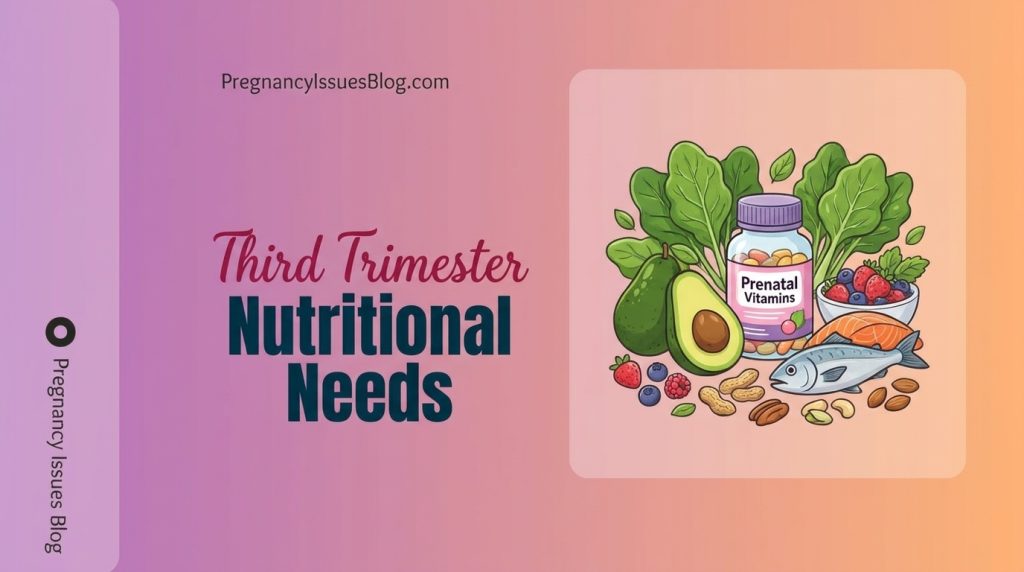
Think of it as a “performance snack”, an extra avocado, a bowl of Greek yogurt with nuts, or a hearty chicken salad.
2. The Iron and Blood Surge
Your blood volume has peaked by the third trimester.
Because you are preparing for birth, a process that naturally involves blood loss, your body becomes an iron-hoarding machine.
While the first trimester focus was on keeping food down, the third trimester focus is on Iron and Vitamin C.
Your baby is also currently busy building up their own iron stores to last them through the first six months of life.
If you don’t eat enough iron now, you’ll likely feel a level of exhaustion that even “pregnancy tired” can’t explain.
3. The Brain and Bone “Bulk-Up”
About 70% of your baby’s brain development happens in the final weeks of pregnancy.
This is when Omega-3s (DHA) become non-negotiable.
While the first trimester was about the structure of the brain, the third is about the function.
Simultaneously, the baby’s skeleton is hardening (ossifying).
In the first trimester, their “bones” were mostly soft cartilage.
Now, they are pulling Calcium from your system at an incredible rate.
If your intake is low, your body will literally “borrow” calcium from your own bones to give to the baby.
4. The Space Problem: Nutrition vs. Heartburn
In the first trimester, you might have avoided food because of nausea.
In the third, you might avoid it because your stomach is currently being used as a footstool by your baby.
With your stomach compressed, you can no longer handle “three square meals.”
The third trimester requires a shift to nutrient density.
You need to make every bite count because you’ll get full much faster.
The Grazing Strategy: Switch to 5–6 mini-meals. Focus on “liquid nutrition” like smoothies if physical space is an issue, as they digest faster and are less likely to trigger the dreaded third-trimester heartburn.
Nutrient Focus: Trimester 1 vs. Trimester 3
| Nutrient | First Trimester Focus | Third Trimester Focus |
| Calories | Maintenance level (0 extra). | +450 calories per day. |
| Key Mineral | Folate (Neural tube). | Iron & Calcium (Blood/Bones). |
| Key Fat | General healthy fats. | DHA (Rapid brain growth). |
| Eating Style | “Survival” (Whatever stays down). | “Density” (Small, frequent, high-protein). |
Conclusion
Your body is a smart machine.
It knows that the needs of a grape-sized embryo are vastly different from those of a 7-pound infant.
By shifting your focus from “preventative” vitamins in the beginning to “growth-fueling” macros at the end, you’re giving your baby the best possible start, and making your own recovery much easier.