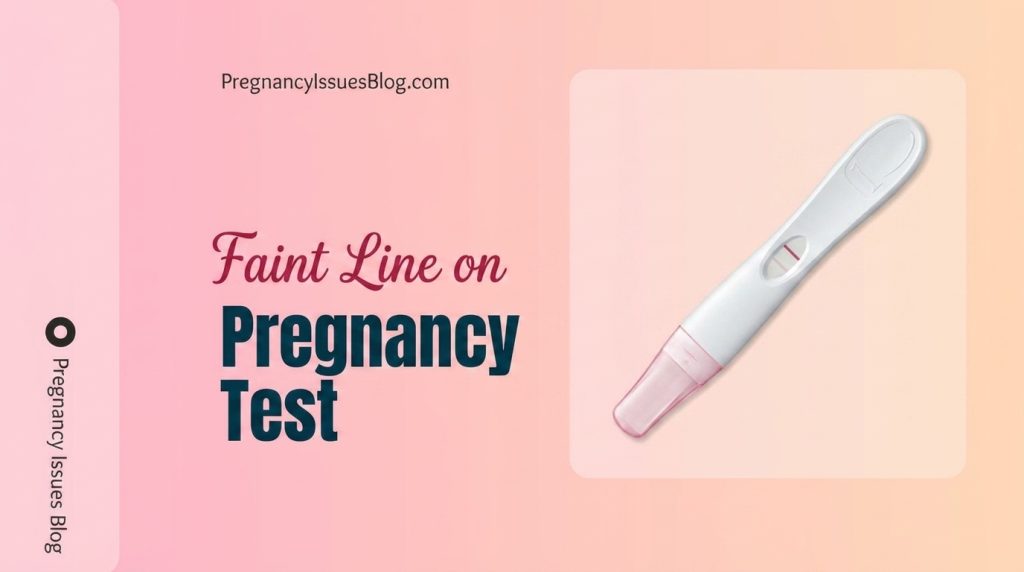
Squinting at a pregnancy test under the brightest light in your bathroom is a rite of passage for many hopeful parents.
You see it, a ghost of a line, a shadow, a “squinter.”
Your heart races, but the uncertainty is paralyzing.
Is it a “yes,” or is your mind playing tricks on you?
In the world of pregnancy tests, a faint line can be one of three things: a very early positive, a frustrating evaporation line, or a sign of a chemical pregnancy.
Here is exactly how to decode that sliver of hope.
Table of Contents
Toggle1. A Line is a Line (Usually)
The most common reason for a faint line is simply that you are pregnant, but it is very early.
Pregnancy tests are designed to detect Human Chorionic Gonadotropin (hCG), a hormone produced after an embryo implants in the uterine wall.
In the very early stages, your hCG concentration might be just at the threshold of the test’s sensitivity (often around 25 mIU/mL for standard tests or 10 mIU/mL for “early result” versions).
Because the hormone levels are low, the chemical reaction on the test strip is weak, resulting in a faint line.
2. The Evaporation Line vs. A True Positive
This is where most of the confusion happens.
An evaporation line occurs when urine dries on the test strip, leaving a faint, colorless streak where the positive line would have been.
-
Timing: If the line appeared within the “read time” (usually 3–5 minutes), it is likely a positive. If you found the line an hour later, it is almost certainly an evaporation line.
-
The Indent: An indentation line is a groove on the test where the dye is supposed to sit. If the light hits it just right, you might see the “shadow” of that groove, which contains no dye at all.
3. The Color Check
This is the most reliable way to tell the difference at home.
-
True Positive: A real positive line will have color. If you are using a pink-dye test, the faint line must be pink. If it’s a blue-dye test, it must be blue.
-
Evap/Indent Line: These lines are typically grey, colorless, or look like a “watermark.” If there is no pigment in the line, the test has not detected hCG.
4. The Role of Dilution
If you tested in the afternoon after drinking three glasses of water, your urine is likely diluted.
This “waters down” the concentration of hCG, making a line appear much fainter than it actually is.
This is why doctors recommend using First Morning Urine (FMU).
After sleeping, your urine has been in your bladder for hours, allowing the hormone levels to concentrate.
5. When the Line Doesn’t Get Darker
In a healthy early pregnancy, hCG levels typically double every 48 to 72 hours.
If you take a test today and another in two days, the line should be noticeably darker.
If the line remains incredibly faint for several days or starts to fade, it may indicate a chemical pregnancy.
This is a very early miscarriage that occurs shortly after implantation.
While heartbreaking, it is a sign that conception was possible, and it is a common occurrence that often goes unnoticed by those who aren’t testing early.
What to Do Next: The 48-Hour Rule
If you see a faint line today, the best thing you can do, as difficult as it is, is to wait 48 hours before testing again.
This gives your body enough time to double its $hCG$ production, turning that “squinter” into a definitive, undeniable “yes.”
If you want a clearer answer sooner, skip the manual strips and try a Digital Test.
These are slightly less sensitive than manual strips, but they remove the guesswork by providing a clear “Pregnant” or “Not Pregnant” reading.