We’ve all been there: you’re minding your own business, perhaps enjoying a Greek yogurt, when someone, a friend, a stranger on a forum, or a TikTok creator, drops a “knowledge bomb.”
They tell you that you must drink a specific tea to avoid labor complications, or that a certain fruit is “toxic” for fetal brain development.
In the high-stakes world of pregnancy, these stories are compelling because they are personal.
But there is a massive difference between a story and a study.
In an era of information overload, your most important prenatal skill might not be choosing the right kale, but rather, learning how to distinguish evidence from anecdote.
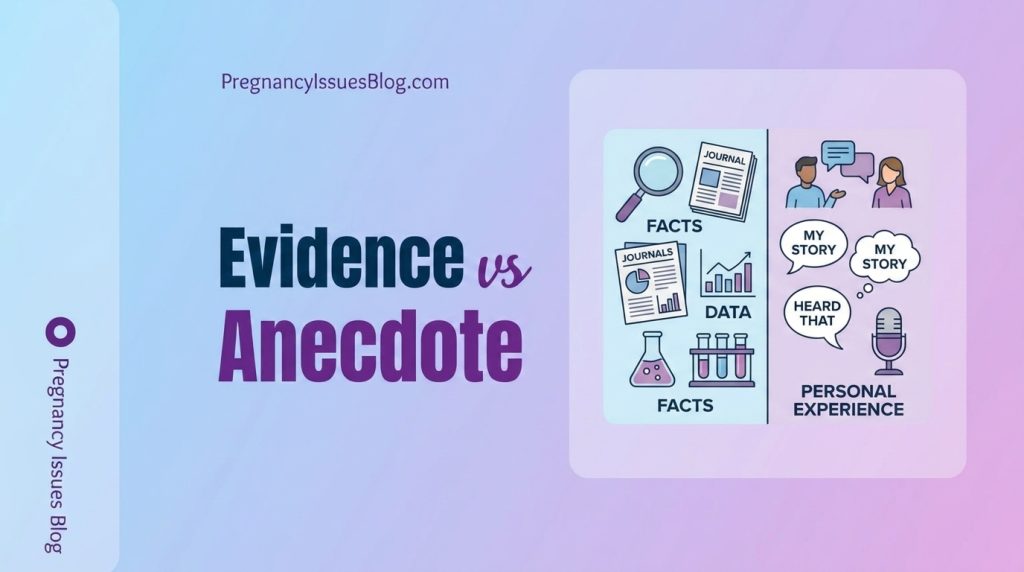
Evidence vs. Anecdote: How to Tell What’s Real
The internet has democratized information, but it has also flattened it.
A peer-reviewed study involving 50,000 women often carries the same visual “weight” in your social media feed as a post from a “Wellness Mama” who had a great birth and thinks it was because she ate three pineapples a day.
To protect your peace, and your baby’s health, you need to know how to filter the noise.
1. The Power of the “N-of-1”
An anecdote is a personal account.
In science, we call this an “N-of-1” (a sample size of one).
Anecdotes are powerful because they have a face and a voice.
If your best friend tells you that a specific herbal supplement cured her morning sickness, you are biologically primed to believe her.
However, an anecdote doesn’t account for variables.
Did her morning sickness go away because of the herb, or because she hit 12 weeks pregnant and her hormones shifted naturally?
Science or Evidence uses large groups of people and “control groups” to isolate those variables and see if the herb actually does the work.
2. The Hierarchy of Evidence
Not all research is created equal.
Scientists use a pyramid to rank how much we should trust a piece of information.
-
The Bottom (Case Reports/Opinions): This is where anecdotes live. It’s a starting point for research, but not a basis for medical advice.
-
The Middle (Observational Studies): Researchers look at groups of people and find patterns (e.g., “Women who eat more fish tend to have babies with higher birth weights”). These are great for finding links but don’t always prove cause and effect.
-
The Top (Randomized Controlled Trials & Systematic Reviews): This is the gold standard. This is when researchers take thousands of studies, mash them together, and look for a universal truth that holds up under scrutiny.
3. Spotting the Red Flags
When you’re reading a blog or watching a reel, keep an eye out for these “Anecdote Alerts”:
-
The “One Secret” Claim: If advice claims to be a “secret” that “doctors don’t want you to know,” it is almost certainly a myth. Real nutrition science is published openly.
-
Absolute Language: Phrases like “Always,” “Never,” or “Guaranteed” are red flags. Real science is full of “may,” “tends to,” and “more research is needed.”
-
The Link to a Shop: If the person giving the advice also happens to sell the “solution” (like a $60 prenatal powder), their evidence is likely biased toward their bank account.
4. How to Fact-Check Like a Pro
You don’t need to be a scientist to verify information. You just need a better search strategy.
Try the SIFT Method:
Stop: Don’t hit share or buy yet.
Investigate the source: Who is this person? Do they have credentials (RD, MD, PhD)?
Find better coverage: Search for the topic on Google Scholar or the WHO website. Does the advice hold up there?
Trace: Where did their “fact” come from? If they say “studies show,” but don’t link the study, be suspicious.
Conclusion
Anecdotes are wonderful for finding community and feeling less alone in your pregnancy journey.
It’s great to hear that your neighbor loved her pregnancy diet.
But when it comes to the nutritional safety of your baby, don’t let a “good story” override a “good study.”
Your baby deserves a foundation built on facts, not just “likes.”
Next time you read a viral health tip, ask yourself: “Is this a sample of one, or a consensus of many?”