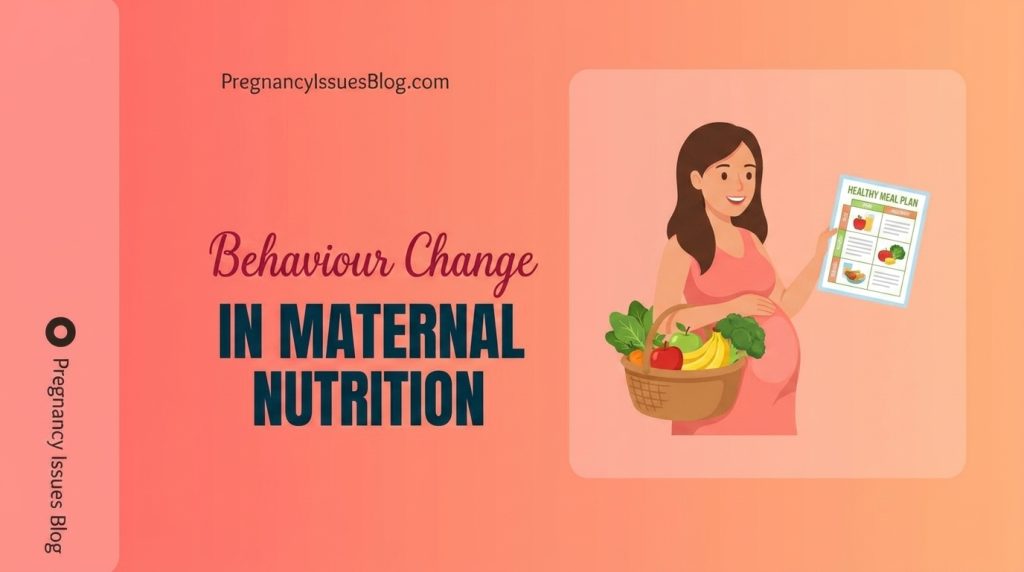
If you’ve ever sat in a doctor’s office nodding along to advice about “increasing leafy green intake” while secretly planning to drive straight to a fast-food window, you’ve experienced the Knowledge-Action Gap.
In maternal health, we often treat nutrition as a simple matter of education: if she knows what to eat, she will eat it.
But behavior change is rarely a straight line.
It’s a complex psychological and biological battleground.
Here is the breakdown of why turning “knowing” into “doing” is the hardest part of pregnancy.
Table of Contents
ToggleWhy Behaviour Change in Maternal Nutrition Is Harder Than It Looks
Most prenatal care focuses on the “What”: What vitamins to take, what fish to avoid, and what protein goals to hit.
But very little time is spent on the “How”: How do you actually change 20 or 30 years of eating habits while you are simultaneously dealing with the greatest physiological upheaval of your life?
Understanding the science of behavior change is the first step in forgiving yourself for the days when the “doing” doesn’t match the “knowing.”
1. The Exhaustion of “High-Stakes” Thinking
Every decision during pregnancy feels weighted with consequence.
Is this lettuce washed?
Is this cheese pasteurized?
Is there too much sugar in this yogurt?
This constant monitoring creates massive cognitive load.
Psychologists know that willpower is like a battery, it drains throughout the day.
By 6:00 PM, after navigating work, physical discomfort, and the mental load of impending motherhood, your “decision battery” is empty.
This is why you can be an expert on the benefits of Omega-3s and still reach for a box of crackers for dinner.
Your brain simply doesn’t have the energy left to execute a complex, “correct” meal.
2. The Habit Loop and the Pregnancy “Veto”
Habits are the brain’s way of saving energy.
They are neurological “short-cuts.”
When you are stressed or tired, your brain defaults to these old loops because they require zero effort.
During pregnancy, this is complicated by biological aversions.
You might know that a spinach omelet is the gold standard for breakfast, but if your first-trimester hormones have decided that eggs are a biological threat, your body will “veto” your knowledge every time.
In the battle between a nutritional textbook and a wave of nausea, the nausea always wins.
3. The “Friction” of Healthy Eating
Behavioral science tells us that humans are path-of-least-resistance creatures.
We don’t necessarily choose what is “best”; we choose what is easiest.
If eating well requires:
-
Finding a recipe.
-
Checking for specific safety guidelines.
-
Driving to a grocery store for fresh produce.
-
Standing for 30 minutes to prep.
…that is a high-friction activity.
If “bad” eating (like processed snacks) requires only opening a cabinet, the friction is zero.
For many pregnant women, especially those facing “time poverty” or financial stress, the friction of healthy eating is simply too high to overcome consistently, regardless of how much they know.
4. The Trap of All-or-Nothing Thinking
We tend to view pregnancy nutrition as a pass/fail exam.
We believe that if we didn’t eat the “perfect” breakfast, we’ve already failed for the day, so we might as well eat whatever we want for lunch and dinner.
This is the Perfectionism Paradox.
The guilt associated with “failing” actually makes it harder to change.
Shame is a “de-activating” emotion; it makes us want to hide and give up.
Resilience, on the other hand, comes from realizing that one “off” meal doesn’t invalidate your knowledge or your efforts.
Strategies That Actually Work
If you want to move from knowing to doing, stop relying on willpower and start relying on systems:
-
Implementation Intentions: Instead of saying “I will eat more fruit,” say “When I finish my afternoon meeting, I will eat one apple that is already sitting on my desk.” This “If-Then” logic takes the decision-making out of the moment.
-
Reduce Friction: Buy the pre-washed spinach. Buy the pre-chopped fruit. If you have to work for your nutrients, you are less likely to eat them when you’re tired.
-
The “Good Enough” Plate: Aim for a “B+” diet. A frozen bean burrito with a handful of pre-washed greens is a massive win compared to nothing at all.
Conclusion
Behavior change is a skill, not a personality trait.
If you are struggling to do what you know you should, it’s not because you don’t care about your baby; it’s because your current environment and biological state are making the “doing” incredibly difficult.
By lowering the friction and increasing self-compassion, you can bridge the gap one small bite at a time.