When we hear the word “research,” we often imagine white lab coats and petri dishes.
But in the world of public health and maternal nutrition, the most powerful tool isn’t a microscope, it’s a well-designed survey.
If you’ve ever read a headline saying, “70% of pregnant women in urban areas aren’t getting enough Vitamin D,” you’re likely looking at the results of a cross-sectional survey.
It is the “GPS” of health research, telling us exactly where we are so we can figure out where we need to go.
Table of Contents
ToggleWhat a Cross-Sectional Survey Actually Is
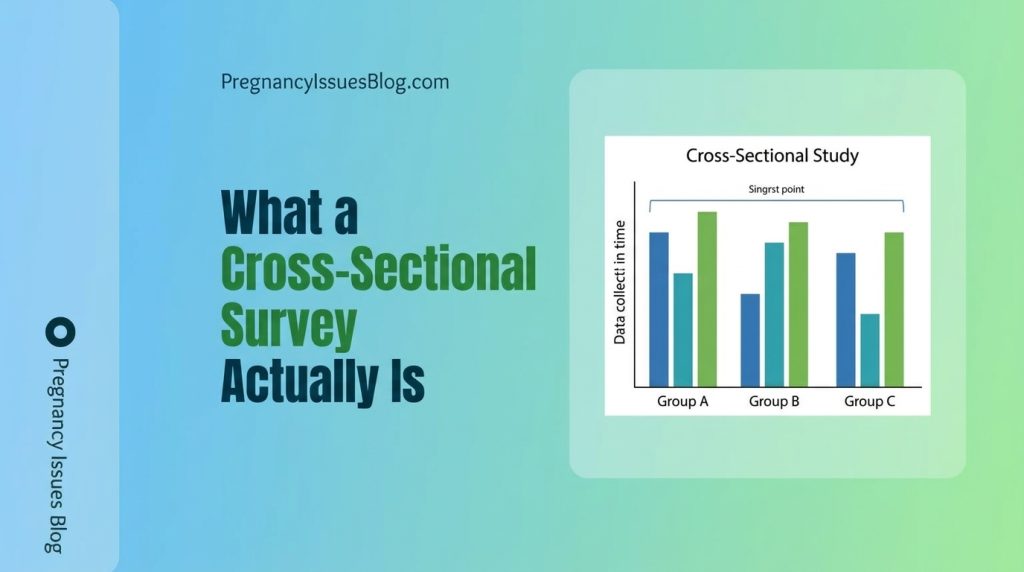
In the simplest terms, a cross-sectional survey is a snapshot.
Imagine walking into a crowded room, taking a high-resolution photograph, and then analyzing everyone in that photo.
You can see who is wearing a hat, who is tall, and who is eating a snack.
What you can’t see is what they were doing ten minutes ago or what they will do tomorrow.
In health research, this means we look at a specific group of people (like pregnant women in their second trimester) at one specific point in time.
We ask them questions about their diet, their vitamins, and their habits right now.
The Difference Between the “Photo” and the “Movie”
To understand why researchers choose this method, you have to compare it to its sibling: the Longitudinal Study.
-
Longitudinal Study (The Movie): This follows the same group of people over years or even decades. It’s great for seeing how childhood nutrition affects adult heart health, but it is incredibly expensive and takes a lifetime to finish.
-
Cross-Sectional Study (The Photo): This looks at different groups of people at once. It’s fast, efficient, and gives us an immediate “pulse check” on a population.
Why It’s the “Right Method” for Pregnancy
Pregnancy is a sprint, not a marathon.
Because the window for intervention is only 40 weeks, researchers need data now.
Here is why the cross-sectional method is the MVP of maternal research:
-
Speed: We can collect data from 1,000 women in a month. By the time a longitudinal study was finished, the babies would be in high school.
-
Feasibility: Expectant mothers are busy. They are navigating appointments, work, and physical fatigue. Asking them to fill out one 15-minute survey (Cross-Sectional) is much more realistic than asking them to keep a food diary for three years (Longitudinal).
-
Hypothesis Generation: These surveys are brilliant at spotting trends. If a survey shows that women who use social media for info tend to eat more folic acid, it gives researchers a “clue” to investigate further.
Decoding Nutrition Behaviour
When we study pregnancy nutrition, we aren’t just looking at what’s on the plate; we’re looking at the behaviour behind it.
A cross-sectional survey allows us to compare “Variables.”
The Research Table: What We Compare
| Variable A (Demographics) | Variable B (Nutritional Practice) | The Goal | | :— | :— | :— | | Education Level | Use of Iron Supplements | Does education affect pill-taking? | | Urban vs. Rural | Fruit/Vegetable Intake | Does location affect food access? | | Age Group | Knowledge of Folate | Are younger moms better informed? |
The “Catch”: Correlation vs. Causation
The biggest mistake people make with cross-sectional data is assuming one thing caused another.
If a survey shows that women who drink ginger tea have less morning sickness, we can say they are correlated.
We cannot say the tea caused the relief, it could be that women with milder nausea are the only ones who can stomach the tea in the first place.
We also have to deal with Recall Bias.
If I ask you what you ate last Tuesday, you might give me your “best guess” (or what you wish you had eaten), which can slightly skew the data.
The Bottom Line
Cross-sectional surveys are the foundation of public health.
They are the reason we have specific nutrition programs, targeted vitamin subsidies, and better clinic education.
By taking a “snapshot” of what pregnant women are doing right now, researchers can build a better, healthier “movie” for the next generation.
If you were participating in a nutrition study, would you prefer a one-time detailed survey or a shorter weekly check-in over several months?