Welcome to the second trimester, mama!
You’ve likely traded in the morning sickness and the “comatose-level” fatigue for a bit more energy and a visible, adorable bump.
But while this stage is famously called the “Honeymoon Phase,” it isn’t always smooth sailing.
As your baby goes through a massive growth spurt, your ligaments stretch, your center of gravity shifts, and your organs start getting rearranged.
Here is how to identify and find relief for the most common “growing pains” of the second trimester.
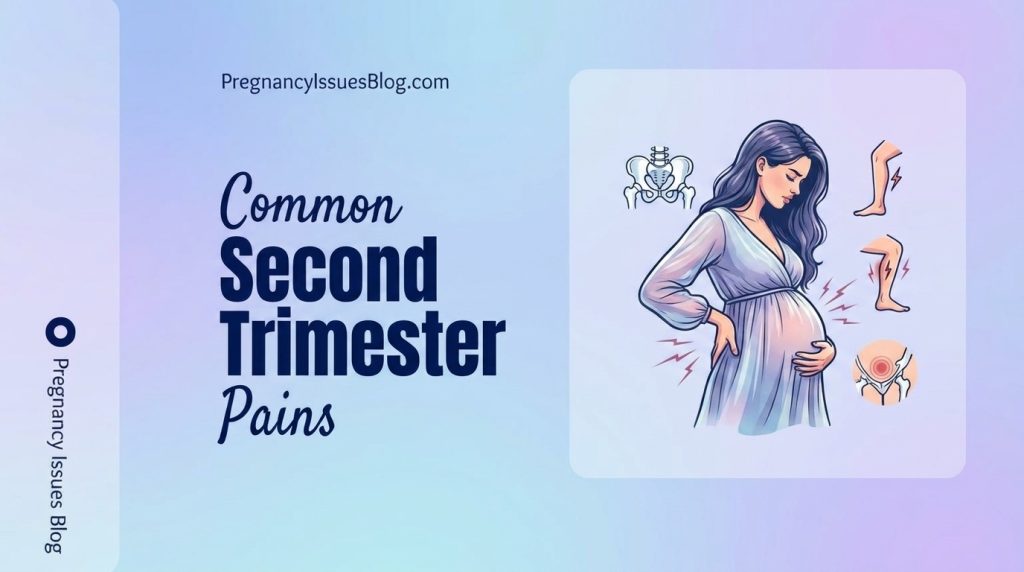
1. Round Ligament Pain: The Sudden Jolt
This is perhaps the most common second-trimester complaint.
The round ligaments support your uterus by connecting it to your groin. As the uterus grows, these ligaments stretch like rubber bands.
-
-
The Feeling: A sharp, jabbing pain in your lower abdomen or groin, usually triggered by sudden movement, like sneezing, coughing, or rolling over in bed.
-
The Relief: Move slowly! If you’re about to sneeze, try to flex your hips or lean forward to take the tension off the ligaments.
-
2. Backaches and the Center of Gravity Shift
By week 20, your center of gravity moves forward.
To compensate, your body naturally leans back, which puts significant strain on your lower back muscles.
Additionally, the hormone Relaxin is hard at work loosening your joints to prepare for birth, which can make your spine feel a bit “wobbly.”
-
The Relief: Focus on posture. Avoid locking your knees and try to sit in chairs with good lumbar support. A maternity support belt can be a literal lifesaver by lifting some of the bump’s weight off your pelvic floor and back.
3. Pelvic Pressure (Symphysis Pubis Dysfunction)
If it feels like your pelvic bones are “grinding” or if you have a sharp pain right in the center of your pubic bone, you might be experiencing SPD.
This is caused by the ligaments that keep your pelvic bones aligned becoming too relaxed.
-
The Relief: Keep your legs symmetrical! Try to avoid standing on one leg (sit down to put on pants) and sleep with a pillow between your knees to keep your hips aligned.
4. The Midnight Leg Cramps
There you are, sleeping soundly, when suddenly a “charley horse” strikes your calf with the force of a thousand suns.
While scientists aren’t 100% sure why this happens, it’s likely a combination of carrying extra weight and a potential imbalance in minerals like Calcium or Magnesium.
-
The Relief: The moment a cramp hits, flex your foot upward (toes toward your shin). To prevent them, stay hydrated and consider a magnesium supplement or a warm bath before bed.
5. Braxton Hicks: The “Practice” Contractions
Starting around week 20, you might feel your uterus tighten for 30-60 seconds and then relax.
These are “practice” contractions.
Unlike real labor, they are usually irregular, painless (though uncomfortable), and go away if you change positions.
-
The Relief: Often, Braxton Hicks are a sign of dehydration or a full bladder. Drink a large glass of water, empty your bladder, and lie down on your left side.
Your Second Trimester Relief Toolbox
| Pain Type | Top Relief Strategy | Why it Works |
| Back Pain | Prenatal Yoga/Pelvic Tilts | Strengthens core and stretches tight muscles. |
| Leg Cramps | Magnesium & Hydration | Supports muscle contraction and nerve function. |
| Swelling | Compression Socks | Improves circulation and prevents fluid pooling. |
| General Ache | Warm (not hot) Bath | Relaxes the “Relaxin-soaked” ligaments. |
When to Call Your Doctor
While most of these pains are just signs of a growing baby, you should reach out to your provider if you experience:
-
Severe or persistent abdominal pain that doesn’t go away with rest.
-
Regular contractions (more than 4 in an hour) before 37 weeks.
-
Vaginal bleeding or a sudden change in discharge.
-
Extreme swelling in your hands or face (a potential sign of preeclampsia).
Conclusion
The second trimester is a remarkable time of transformation.
While the “aches” are real, they are usually a sign that your body is successfully adapting to its new, temporary role as a human incubator.
Listen to your body, take the “slow” moments when you need them, and don’t be afraid to use that pregnancy pillow for all it’s worth.
Are you currently using any supportive gear like a maternity belt or a specific pillow to help with your back pain, or are you looking for more natural stretching routines?