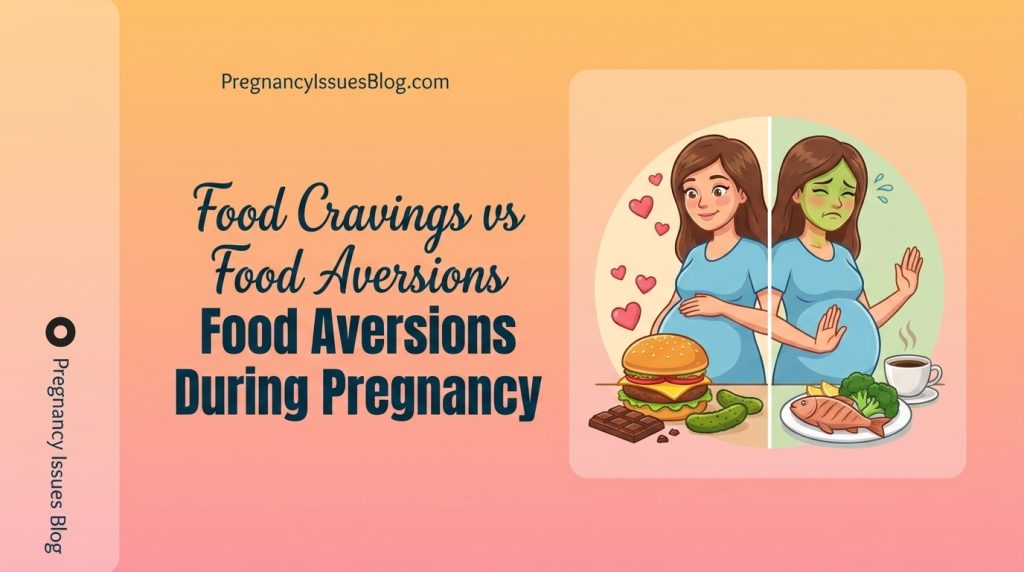
One minute, you would trade your car for a jar of spicy pickles; the next, the mere sight of a head of broccoli, a vegetable you usually love, makes you want to move to a different continent.
Welcome to the biological roller coaster of pregnancy appetite.
While these shifts are often played for laughs in movies, they are driven by complex physiological and evolutionary mechanisms.
Understanding the “why” behind your sudden hatred of coffee or your midnight ice cream runs can help you navigate your nutrition without the guilt.
Table of Contents
ToggleFood Cravings vs Food Aversions During Pregnancy: The Science & Management
Pregnancy is perhaps the only time in your life when your relationship with food changes overnight.
These aren’t just “fussy eating” habits; they are biological directives.
To manage them, we first have to look at what’s happening under the hood.
The Science of Cravings: Is it a “Need” or a “Want”?
Between 50% and 90% of women experience specific food cravings during pregnancy.
For a long time, the popular theory was that cravings were the body’s way of signaling a nutrient deficiency; for example, craving a burger meant you were low on iron.
While there is some truth to this in extreme cases (like Pica), modern science suggests that hormones are the primary drivers.
A surge in Neuropeptide Y (NPY), a potent appetite stimulant, and shifts in your “reward” receptors make certain foods, usually high-calorie, high-fat, or high-sugar ones, seem irresistible.
Your brain is essentially trying to ensure you have enough energy stores to support a growing infant.
The Science of Aversions: Your Evolutionary Bodyguard
Aversions are the opposite: a sudden, intense loathing for a specific food.
Interestingly, the most common aversions are often foods that are technically “healthy,” such as leafy greens, eggs, or poultry.
Evolutionary psychologists suggest this is a survival mechanism called the Maternal Immune Surveillance theory.
During the first trimester, when the baby is most vulnerable, your body becomes hyper-sensitive to “bitter” or “pungent” smells.
In nature, bitterness often signaled toxins, and meat could carry parasites or bacteria.
Your aversions are essentially an overprotective “bodyguard” trying to shield the fetus from potential harm.
Managing Aversions Nutritionally
When the smell of cooking meat or steamed vegetables makes you nauseous, “eating a balanced diet” feels impossible.
Here is how to manage:
-
The Temperature Trick: Cold foods often have less aroma than hot foods. If you can’t stand the smell of a roast chicken, try cold sliced turkey or a chilled pasta salad.
-
Hide the Greens: If salads are out of the question, blend spinach into a fruit smoothie with frozen berries and Greek yogurt. The cold temperature and the sweetness of the fruit mask the “bitter” notes of the greens.
-
Liquid Nutrition: On days when solid food feels like a chore, focus on nutrient-dense broths or protein shakes.
Managing Cravings Without the Guilt
Cravings aren’t the enemy, but they can lead to a “blood sugar roller coaster” if they are exclusively focused on refined sweets.
-
The Pairing Rule: If you crave something sugary (like a donut or candy), pair it with a protein or healthy fat (like a handful of nuts or a piece of cheese). This slows down sugar absorption and prevents the inevitable “crash” that leaves you feeling more tired.
-
Smart Swaps: Craving something salty and crunchy? Try air-popped popcorn with nutritional yeast or lightly salted nuts instead of greasy potato chips.
-
Address the “Why”: Sometimes a craving for “everything in sight” is actually a sign of dehydration or lack of sleep. Try drinking a large glass of water and resting for 20 minutes before acting on a massive craving.
When Cravings Turn Strange: Pica
If you find yourself desperately wanting to chew on ice, dirt, laundry detergent, or chalk, this is known as Pica.
This is a clinical sign that your body is likely deficient in iron or zinc.
If you experience this, don’t be embarrassed, it’s a biological signal.
Reach out to your doctor immediately for a blood test.
Conclusion
Your body is currently a high-stakes construction site.
Some days the foreman (your hormones) is going to demand chocolate, and some days it’s going to shut down the kitchen entirely because it smells a “toxin” (the broccoli).
The goal isn’t to be a perfect eater every day; it’s to find the “middle ground” where you respect your body’s signals while ensuring the essential building blocks, like protein, iron, and folate, find their way into your system in whatever form stays down.