The first trimester is often called the “invisible” trimester.
To the outside world, you look exactly the same, but on the inside, you are essentially a high-performance factory running 24/7.
While we have better tracking apps now and wearable tech than ever, the biological “magic” of weeks 1 through 12 remains a wild, exhausting, and miraculous ride.
Here is your week-by-week roadmap to the changes happening in your body and your baby during these first few pivotal months.
Table of Contents
ToggleWeeks 1–4: The Ghost in the Machine
Technically, for the first two weeks, you aren’t even pregnant. Doctors count from the first day of your last period.
-
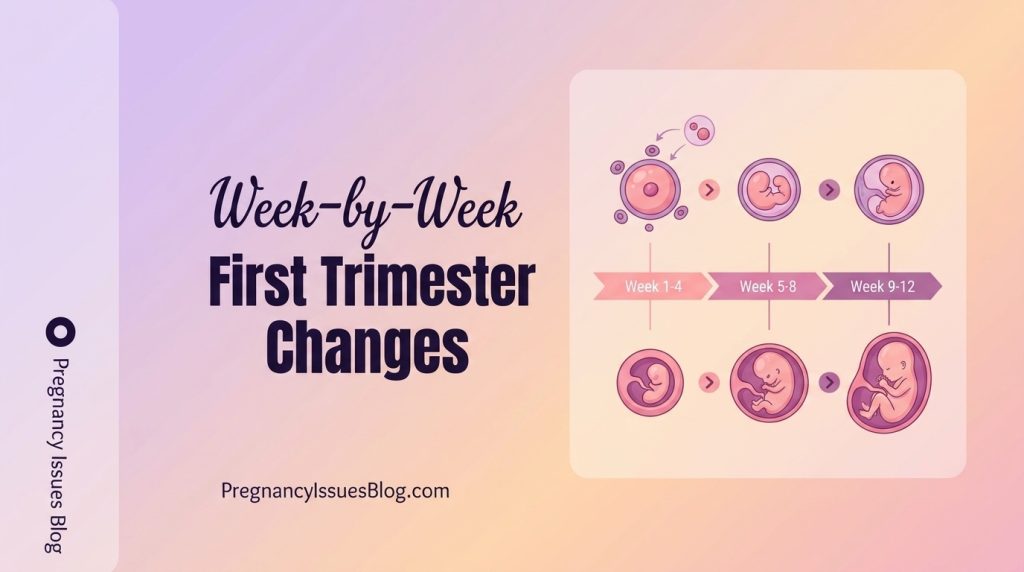
Weeks 1 & 2: Your body is preparing for ovulation. It’s all about estrogen and the “prime” of the uterine lining.
-
Week 3: Fertilization occurs in the Fallopian tube. The zygote begins its journey toward the uterus.
-
Week 4: Implantation. This is the big moment. The blastocyst burrows into your uterine lining. This triggers the release of Human Chorionic Gonadotropin (hCG), the hormone that turns your pregnancy test positive. You might notice “implantation spotting”, a light pink or brown discharge that is perfectly normal.
Weeks 5–8: The “Big Bang” of Development
By week 5, you’ve missed your period, and the reality is likely setting in. This is the period of organogenesis, when all the major systems are “booting up.”
-
Week 5: The embryo looks like a tiny tadpole. The neural tube (which becomes the brain and spinal cord) is forming.
-
Week 6: The “Heartbeat” week. A primitive heart begins to beat at roughly 100–160 beats per minute. You might start feeling the first waves of nausea here.
-
Week 7: Your baby is doubling in size every few days. Tiny “buds” appear that will soon become arms and legs. Your own blood volume is starting to increase, which might make you feel extra thirsty or lightheaded.
-
Week 8: The “tail” at the bottom of the embryo disappears. Eyelids and ears are forming. This is often the week where the “bone-deep” fatigue hits you like a freight train.
Weeks 9–12: From Embryo to Fetus
You are entering the home stretch of the first trimester. The most critical developmental hurdles are being cleared.
-
Week 9: The embryo is officially a fetus. It’s about the size of a cherry. Muscles are starting to develop, and the baby might even be making tiny movements you can’t feel yet.
-
Week 10: All the vital organs, kidneys, intestines, and brain are in place and starting to function. The “tail” is completely gone.
-
Week 11: The baby is officially active, stretching and somersaulting in its amniotic sac. This is usually when you’ll have your first major screening (NIPT) to check on chromosomal health.
-
Week 12: The end of the first trimester! The baby’s reflexes are developing; they can now curl their fingers and make a sucking motion with their mouth. Most importantly for you: the placenta is taking over the production of hormones, which often means your morning sickness starts to subside.
Quick Reference: First Trimester Symptoms
| Week Range | Common Physical Changes |
|---|---|
| Weeks 4-6 | Sore breasts, frequent urination, mild cramping. |
| Weeks 7-9 | Peak nausea (morning sickness), food aversions, fatigue. |
| Weeks 10-12 | Possible “bloat” (the progesterone pooch), clearer skin, better sleep. |
You’re Almost There
The first trimester is a season of endurance.
You are laying the foundation for a new life, and it is okay to feel overwhelmed by the sheer scale of the biological changes.
By the time you hit week 13, you’ll likely feel a surge of energy and a return to your “normal” self, just with a slightly more visible bump to show for it.
Are you currently experiencing any specific symptoms like the “metallic taste” or vivid dreams, or are you in that lucky group that feels relatively normal so far?