We’ve all seen them: the glossy posters in clinic hallways, the brightly colored billboards on the highway, and the government-sponsored social media ads telling us to “Eat 5 a Day” or “Choose Whole Grains.”
These are awareness campaigns.
They are designed to fill a “knowledge gap.”
The problem?
Most of the time, the gap isn’t about knowledge.
Recently, the average person, and especially the average pregnant woman, is more “aware” of nutrition than any generation in history.
Yet, nutritional outcomes remain stubbornly stagnant.
Why?
Because knowing that a vegetable is healthy is a completely different neurological and economic process than putting that vegetable on your plate.
Table of Contents
ToggleWhy Campaigns That Only Raise Awareness Fail
-
I. Introduction
-
The Billboard Fallacy: Why information doesn’t equal transformation.
-
Defining the “Awareness-Practice Gap.”
-
-
II. Awareness vs. Practice: A Mental Roadmap
-
Awareness as “Software” (The data we store).
-
Practice as “Hardware” (The reality of our environment and resources).
-
-
III. Why Awareness Campaigns Fail
-
The Knowledge Deficit Myth: Assuming people are “ignorant” rather than “constrained.”
-
The “Overload” Effect: When too much information leads to choice paralysis.
-
-
IV. The Three Walls Between Knowing and Doing
-
The Economic Wall: The “Health Tax” on fresh food.
-
The Environmental Wall: Food deserts and the “path of least resistance.”
-
The Biological Wall: Stress, cravings, and decision fatigue.
-
-
V. Case Study: Maternal Nutrition
-
Why “Awareness” of iron supplements doesn’t solve the “Practice” of taking them.
-
-
VI. Moving Toward “Action-Oriented” Design
-
Shifting from “What to eat” to “How to make it easy.”
-
The role of “Nudges” and structural change.
-
-
VII. Conclusion
-
Empowerment through enablement, not just education.
-
The Difference Between Nutritional Awareness and Nutritional Practice
If public health were as simple as “telling people what to do,” we would be the healthiest society in human history.
We have more apps, podcasts, and infographics about kale than we know what to do with.
Yet, the disconnect between what we know and what we do has never been wider.
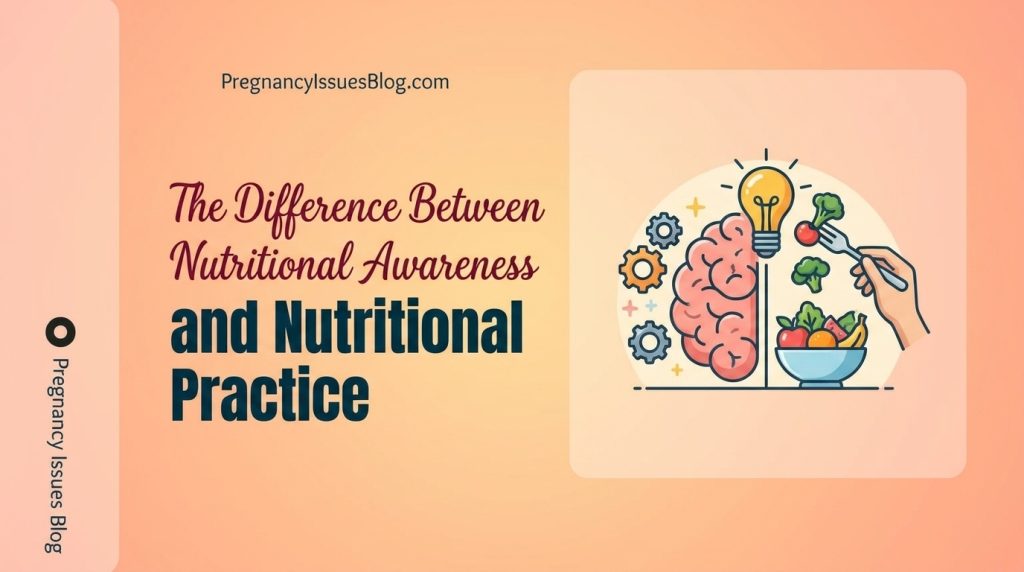
This is the Awareness-Practice Gap.
To bridge it, we have to stop treating people like empty vessels waiting for “facts” and start treating them like complex humans navigating a difficult world.
1. The Myth of the “Knowledge Deficit”
Most nutrition campaigns are built on the “Knowledge Deficit Model.”
This model assumes that if a woman isn’t eating enough protein during pregnancy, it’s because she doesn’t know protein is important.
The Reality: In almost every KAP (Knowledge, Attitudes, Practices) study conducted recently, “Knowledge” scores are remarkably high.
Mothers know they need iron.
They know they need vegetables.
The failure of the campaign happens when it stops at the “head” and never reaches the “hand.”
Awareness campaigns fail because they try to solve an environmental or economic problem with a cognitive solution.
You can’t “aware” your way out of a food desert.
2. The Three Invisible Walls
If a mother “knows” what to eat but doesn’t “do” it, she is likely hitting one of three walls:
-
The Economic Wall: Healthy eating is often a luxury of time and money. When a campaign says “choose fresh,” but “fresh” costs three times as much as “processed” and takes four times as long to prepare, the awareness is useless. It actually creates Nutritional Guilt, which is a stressor that makes healthy choices even harder.
-
The Environmental Wall: Human beings are biologically wired to take the path of least resistance. If the “easy” choice (the corner store) is unhealthy and the “hard” choice (the supermarket two bus rides away) is healthy, the environment will win 90% of the time.
-
The Biological Wall: Stress, especially the chronic stress of poverty or pregnancy, triggers the brain’s “survival mode.” In survival mode, the prefrontal cortex (the part that cares about “awareness”) shuts down, and the limbic system (the part that wants high-calorie comfort food) takes over.
3. Awareness as a “One-Time” Event vs. Practice as a “Daily” Grind
Awareness is a moment of “Aha!”
You see a post, you learn a fact, and you’re done.
Practice, however, is a relentless, 24/7 series of decisions.
A campaign that tells you “Iron is good for your baby” is a one-way broadcast.
It doesn’t help you when you’re nauseous at 7:00 AM and the iron pill smells like a rusty nail.
It doesn’t help you when you have to choose between buying supplements or paying for transport to the clinic.
Practice requires support systems, not just slogans.
4. From “Broadcasting” to “Enabling”
If we want to actually change what people eat, we have to move beyond awareness.
We need campaigns that focus on Implementation Intentions.
Instead of a poster that says: “Eat more fiber,” we need programs that:
-
Reduce Friction: Provide pre-washed, pre-cut vegetables in local shops.
-
Use Nudges: Place healthy options at eye level in clinic kiosks.
-
Address the “How”: Focus on 5-minute recipes that use only three ingredients.
-
Shift the Structure: Advocate for subsidies that make the “healthy” choice the “cheapest” choice.
Conclusion
Awareness is the easy part of public health.
It’s cheap to print a flyer.
It’s hard to change a food system.
But if we want to move the needle on maternal and fetal health, we have to be brave enough to admit that the “Knowledge Gap” is a myth.
People don’t need to be told why to eat well; they need to be shown how to do it within the constraints of their real, messy, and often stressful lives.
Let’s stop building billboards and start building bridges.