When you walk into a clinic for your first antenatal care (ANC) visit, you probably have a list of questions and a heart full of expectations.
In this information age, the global health community has a very specific “gold standard” for what that visit should look like.
But between the guidelines on a PDF in Geneva and the reality of a busy public clinic, there is often a wide, frustrating gap.
Understanding what the World Health Organization (WHO) actually recommends can help you bridge that gap for yourself and your baby.
Table of Contents
ToggleWhat the WHO Says Every Pregnant Woman Should Receive at ANC
In 2016, the World Health Organization shifted the goalposts for maternal health.
They moved away from a model focused purely on “surviving” pregnancy to one focused on “thriving.”
They called it the Positive Pregnancy Experience.
The most significant change was the increase from 4 to 8 “contacts” with healthcare providers.
This wasn’t just to add more appointments to your calendar; it was to ensure that nutrition and support were “drip-fed” throughout the journey rather than rushed in a single session.
The “Gold Standard” Nutritional Interventions
According to the WHO, nutrition is not a footnote; it is a primary medical intervention. Every woman should receive:
-
Daily Iron and Folic Acid (IFA): Specifically, 30 mg to 60 mg of elemental iron and 400 µg (0.4 mg) of folic acid.
-
Calcium Supplementation: In areas where calcium intake is low, this is recommended to prevent preeclampsia.
-
Nutritional Counseling: This is the big one. The WHO states that every woman should be counseled on increasing daily energy and protein intake and the importance of a diverse diet.
The Assessment Standard
It’s not just about what you put in your body, but what the clinic finds.
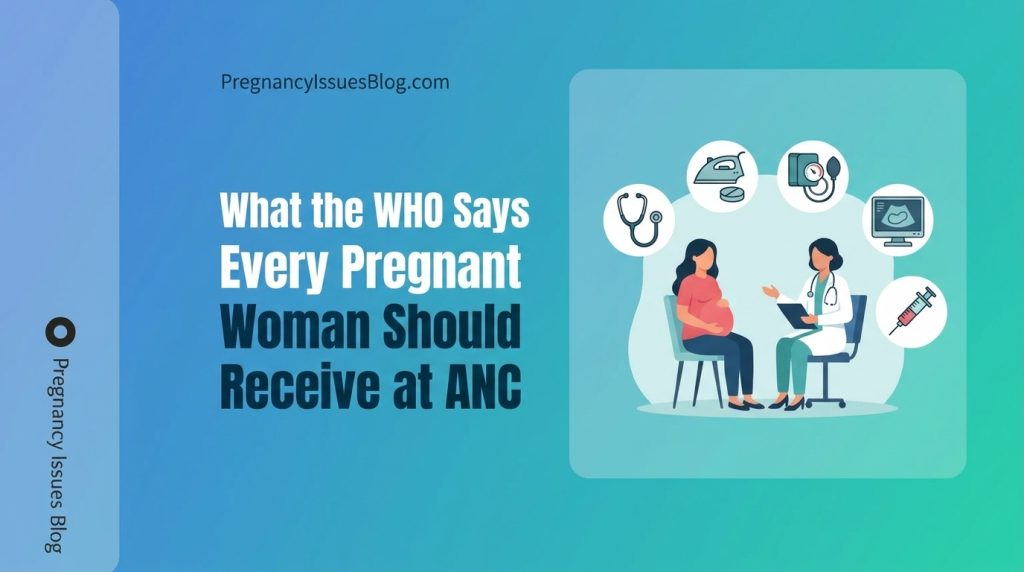
The WHO recommends one ultrasound scan before 24 weeks of gestation to estimate gestational age, detect fetal anomalies, and improve the overall pregnancy experience.
They also mandate screenings for asymptomatic bacteriuria (urine infections), anaemia, and, depending on the region, infections like HIV and Syphilis.
The Reality Gap: The 15-Minute Speed Date
Here is where the “Gold Standard” meets the “Real World.”
In many public health systems, the gap between these recommendations and the actual experience is staggering.
| WHO Recommended | Real-World Common Practice |
| 8 Meaningful Contacts | Often 4 or fewer rushed visits. |
| Tailored Dietary Counseling | A generic “eat well” with no specific guidance. |
| Early Ultrasound (pre-24 weeks) | Often delayed or unavailable due to costs/equipment. |
| Holistic Support | Focus on physical vitals only (BP and weight). |
Why does this gap exist?
It’s usually a mix of “Time Poverty” for providers and a lack of resources.
When a nurse has 50 women in a waiting room, the 20-minute counseling session on how to absorb iron better is usually the first thing to be cut.
The Nutritional “Checklist” Problem
Perhaps the most dangerous gap is the “Pill vs. Plate” problem.
Many clinics are excellent at handing out iron tablets (the “pill”), but they fail at the counseling (the “plate”).
The Reality Check: Simply taking an iron pill isn’t enough if you aren’t told that drinking tea with your meal blocks the iron’s absorption. Without the counseling part of the WHO recommendation, the supplementation part is only half as effective.
How to Advocate for Your “Positive Pregnancy Experience”
If you feel your ANC visits are becoming a series of rushed “checks,” it’s time to use the WHO guidelines as your roadmap.
You don’t need a medical degree to demand the standard of care you deserve.
-
Ask for the “Why”: If you are handed a pill, ask: “How should I take this to make sure my body absorbs it best?”
-
Ask about the “Brain Gold”: “Am I getting enough Choline and DHA in my current diet, or do I need a specific supplement?”
-
Bring a List: Don’t let the rush stop you. Write down three nutritional concerns and don’t leave the chair until they are addressed.
Conclusion
The WHO guidelines are a vision of what is possible, but the clinic is where that vision is implemented.
By knowing that you are entitled to eight contacts, detailed counseling, and early screening, you move from being a passive patient to an active participant in your baby’s development.
The “Gap” is real, but your advocacy is the bridge.